
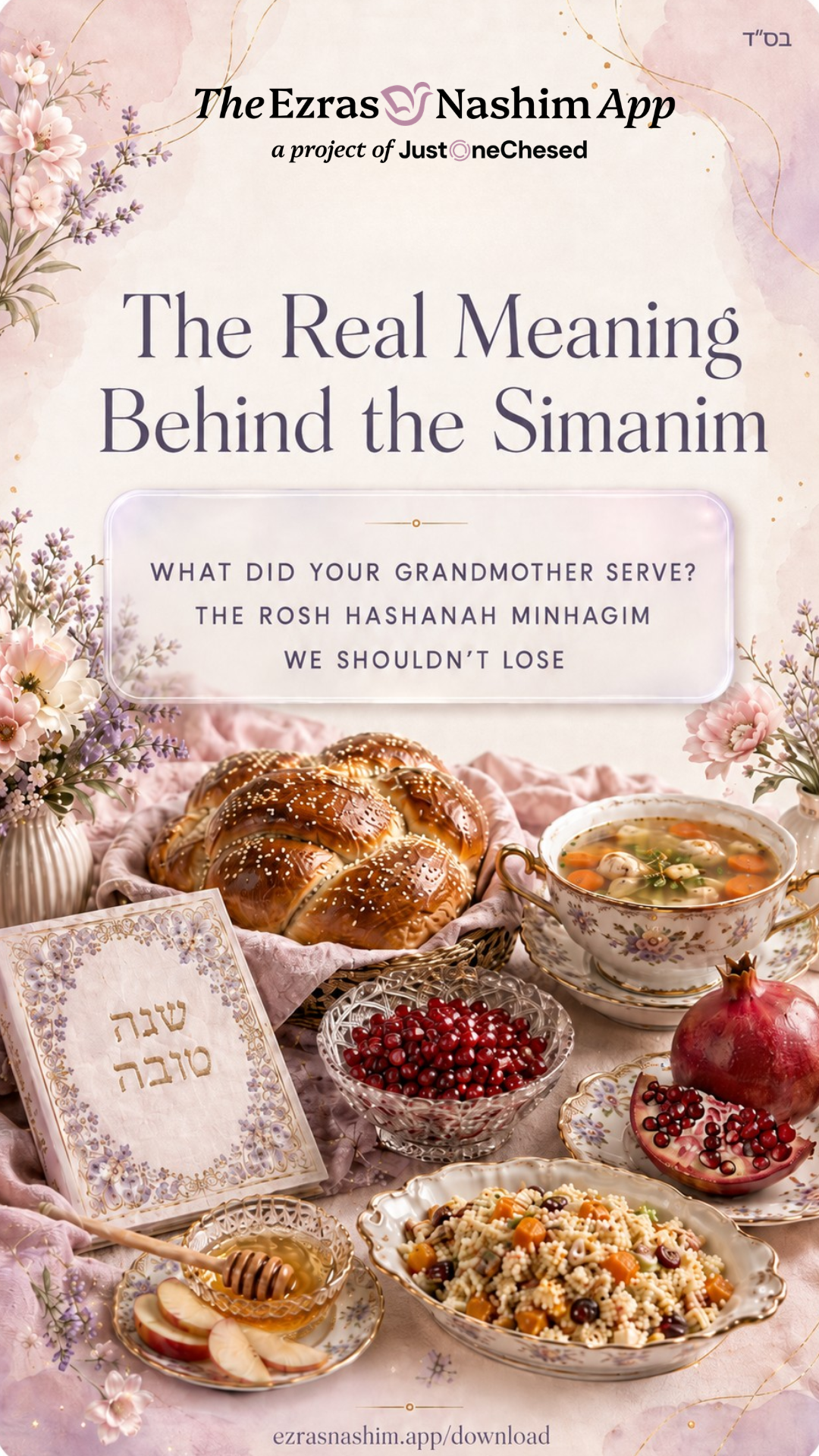
The Ezras Nashim Rosh Hashanah Series: Part 3
Some of the most precious Jewish traditions are never formally taught. They are simply placed on the table.
Every family seems to have at least one Rosh Hashanah custom that makes perfect sense within the family—and requires a full explanation elsewhere.
For Sharon Gomperts, the holiday comes with rules her mother learned at the table of her grandfather, Yosef Chai.
Wear white.
Greet one another cheerfully.
Be especially careful not to break anything.
Her family follows the order of the simanim found in the Ben Ish Chai’s siddur, giving the evening an added connection to its Iraqi Jewish roots.
A Whole Seder in One Pot
For Sharon’s longtime friend and Sephardic Spice Girls partner, Rachel Emquies Sheff, the taste of Rosh Hashanah is her mother Rica’s simanim soup.
Rachel’s parents came from Larache, Morocco, where their families preserved a Spanish-Moroccan Jewish heritage across generations.
The soup brought the simanim together in one pot: leeks, Swiss chard, squash, zucchini, apple, turnip and other vegetables, slowly cooked with meat. After the brachos, it was served as the first course.
It was not only soup. It was family history that could be ladled into a bowl.
Tradition Can Keep Moving
Reyna Simnegar learned Persian Jewish cooking after marrying into a Persian family. She has described a Rosh Hashanah seder filled with symbolic foods, blessings, color, abundance and laughter.
The gathering had an order, but it also felt like a celebration.
Other women preserve the ingredients while changing the presentation.
At a Sephardic Spice Girls cooking event, chef Debby Segura turned lubiyah, the traditional black-eyed peas, into Cowboy Caviar with corn, tomatoes and avocado.
Cookbook author Adeena Sussman similarly lets classic holiday ingredients inspire contemporary dishes, including pomegranate-lacquered salmon and brisket enriched with figs and pomegranate. The recipes are modern; the ingredients still speak the language of the season.
There is no one Rosh Hashanah table.
There is the table you grew up around, the one your husband grew up around, the one you are creating now—and sometimes all three are trying to fit into the same dining room.
Before searching for one more new recipe, ask:
What did your grandmother serve?
Was there a dish that appeared only once a year?
Is there a recipe nobody ever wrote down?
Call your mother. Ask your aunt. Find out why that particular soup, salad, jam or cake appears every Tishrei.
Sometimes the most interesting Rosh Hashanah tradition isn’t hiding in a cookbook. It’s sitting in your mother’s kitchen.
Editor’s Note
This article is based on publicly available writing, interviews, and published food histories. Ezras Nashim did not interview the women featured for this story.