
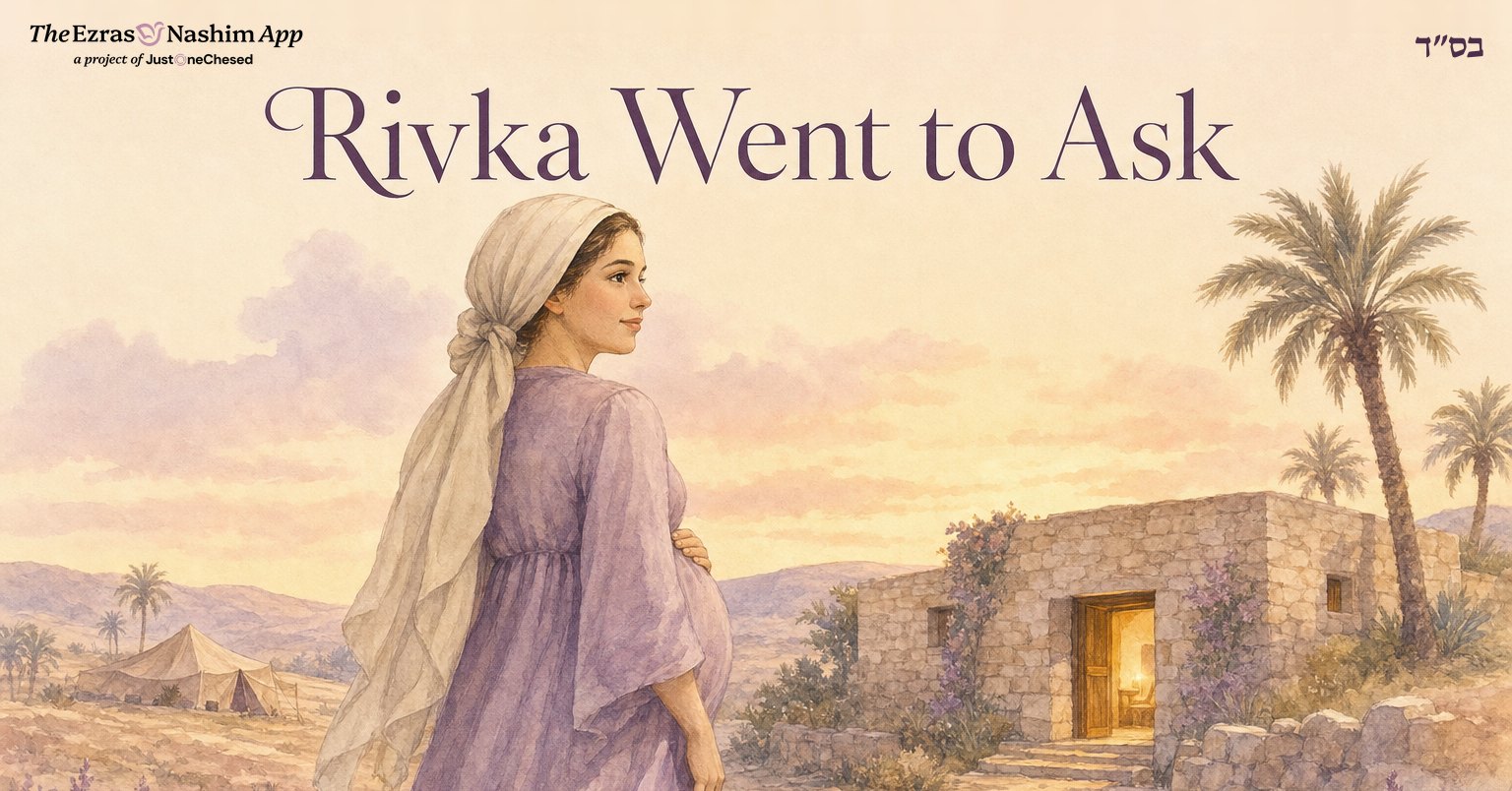
This Shabbos we read Toldos. After twenty years of davening for a child, Rivka was finally expecting, and something felt wrong. What she did next is a lesson for every woman with a question that will not let her sleep.
Yitzchak and Rivka waited twenty years. The Torah says Yitzchak davened "opposite his wife" (Bereishis 25:21), and Rashi, drawing on the Midrash, sets the scene: he stood in one corner and prayed, and she stood in the other corner and prayed. Two people, one longing.
Then the answer came, and with it, pain. "The children struggled within her, and she said, 'If so, why am I?'" (Bereishis 25:22).
Two readings of one cry
Rashi, quoting Bereishis Rabbah, hears a bewildered mother: if the pain of pregnancy is this great, why did I long and pray for it? The Ramban hears something heavier: if this is how it will be, why am I here at all?
Both readings are honest, and neither is the voice of a woman who has stopped believing. The Torah records her words without a syllable of criticism. It has room for a woman who davened for years and then found the blessing harder than she had imagined.
She went to ask
The verse goes on: "She went to inquire of Hashem." Rashi tells us where she went: to the study house of Shem, the son of Noach, so that Hashem would tell her what would become of her. On the next verse, Rashi explains how the answer came: Shem was told through ruach hakodesh, and he told her.
The Ramban adds that in Tanach, seeking Hashem is the language of prayer, as in "I sought Hashem and He answered me" (Tehillim 34:5).
So Rivka did two things at once. She brought her pain to Hashem, and she brought her question to a man of Torah who could help her hear the answer. She did not carry it alone, and she did not let it carry her away.
The question is not the problem
Every woman meets a "why am I" season: a simcha that arrives with exhaustion, a move, a diagnosis, a child who is struggling. Rivka shows that the question itself is not a failure of emunah. What matters is where she takes it.
Take it to Hashem, in your own words, in the corner of a room if that is where you are. And take it to someone who learns: your rav, a rebbetzin, a teacher you trust. The answer Rivka received did not end the struggle; two nations still pushed inside her. But she walked home knowing that the struggle had a purpose.
This Shabbos, when Rivka's question is read aloud, remember that asking was the first step of her answer.