
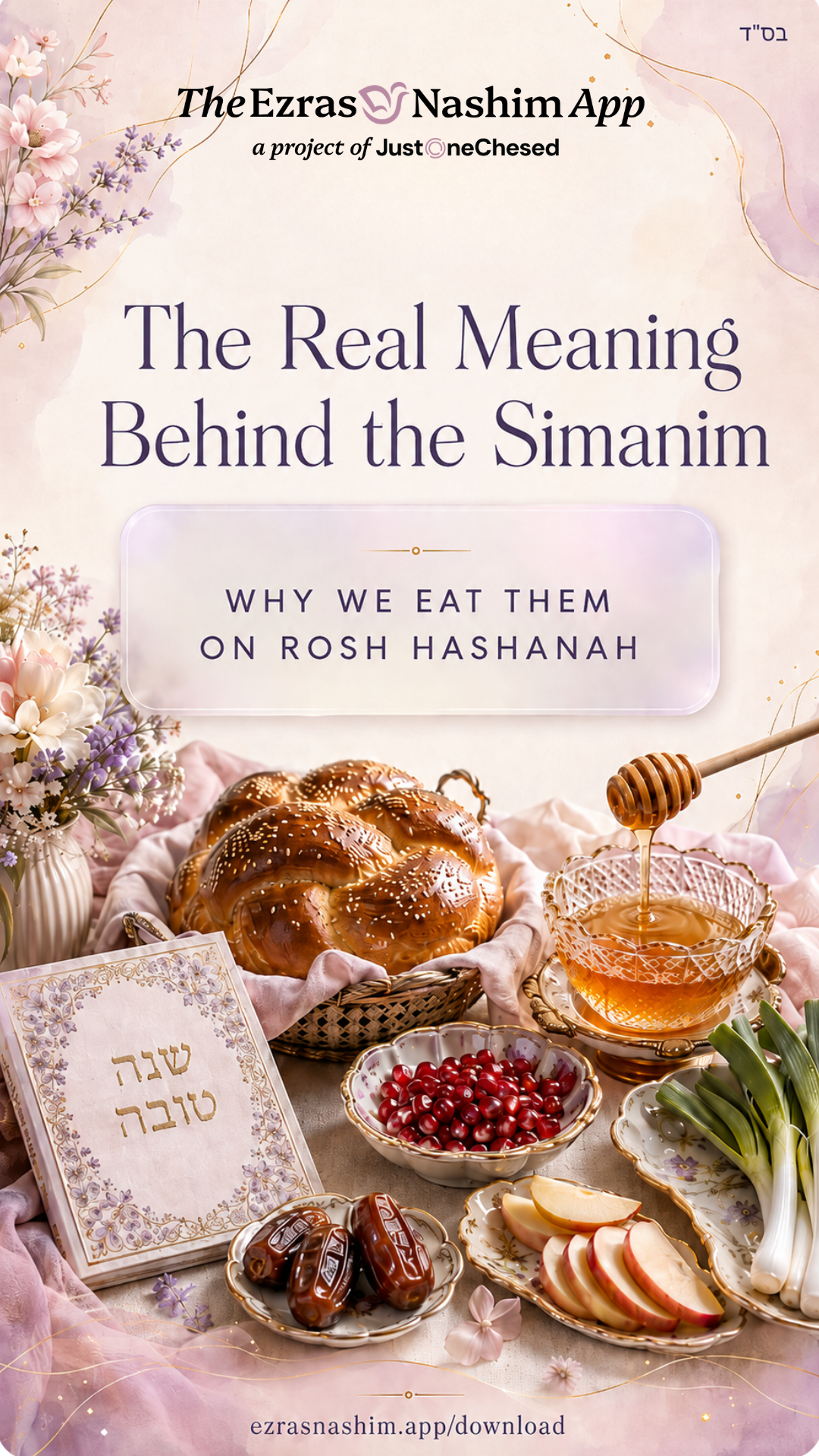
The Ezras Nashim Rosh Hashanah Series: Part 1
There is something about the days before Rosh Hashanah that makes even the supermarket feel different.
The honey isn’t just honey anymore. The pomegranates suddenly look important. You’re inspecting dates, calculating how many round challahs will fit in the freezer and wondering whether anyone in your family actually eats the fish head—or whether it has been making a ceremonial appearance for the last 25 years.
Rosh Hashanah has a way of turning ordinary food into something more.
It Began With Five Foods
The custom of eating simanim did not begin with a beautiful tablescape or a clever holiday menu.
In Maseches Kerisus 6a, Abaye teaches that a person should become accustomed to eating five symbolic foods at the beginning of the year: kara, rubia, karti, silka and tamrei.
They are commonly understood as squash or gourd, beans or fenugreek, leeks, beets or chard, and dates. The exact kitchen translations have varied between communities, but the idea endured: begin the year by placing hopeful signs before us.
The names of the foods inspired short Yehi Ratzon prayers built around Hebrew and Aramaic wordplay.
With rubia, we ask that our merits increase.
With karti, that those who seek our harm be cut off.
With silka, that our adversaries depart.
With tamrei, that our enemies come to an end.
With kara, that an unfavorable decree be torn and our merits be read before Hashem.
These foods are not predictions or guarantees. They give us a way to take the hopes we carry quietly and turn them into tefilla.
From the Gemara to Our Tables
The Shulchan Aruch, Orach Chayim 583 records the simanim and their accompanying requests.
The Rema adds customs now familiar in many homes: dipping a sweet apple into honey and asking for a good, sweet year, and eating a pomegranate while asking that our merits become as numerous as its seeds.
The same section records eating the head of a ram and asking to be “the head and not the tail,” while also recalling the ram offered in place of Yitzchak. Over time, different families and communities developed their own versions and additions.
That is why one Rosh Hashanah table might hold apples and honey, while another is crowded with leeks, beets, black-eyed peas, squash, dates, pomegranate, tongue, fish or an entire pot of simanim soup.
There isn’t only one authentic Rosh Hashanah table.
The foods may change. The accents may change. The recipes certainly change. But Jewish families have been turning food into tefilla for generations.